
Comprehensive Guide to Nintedanib: Uses, Dosage, Side Effects, and More
What is Nintedanib?
Overview of Nintedanib
Generic Name: Nintedanib
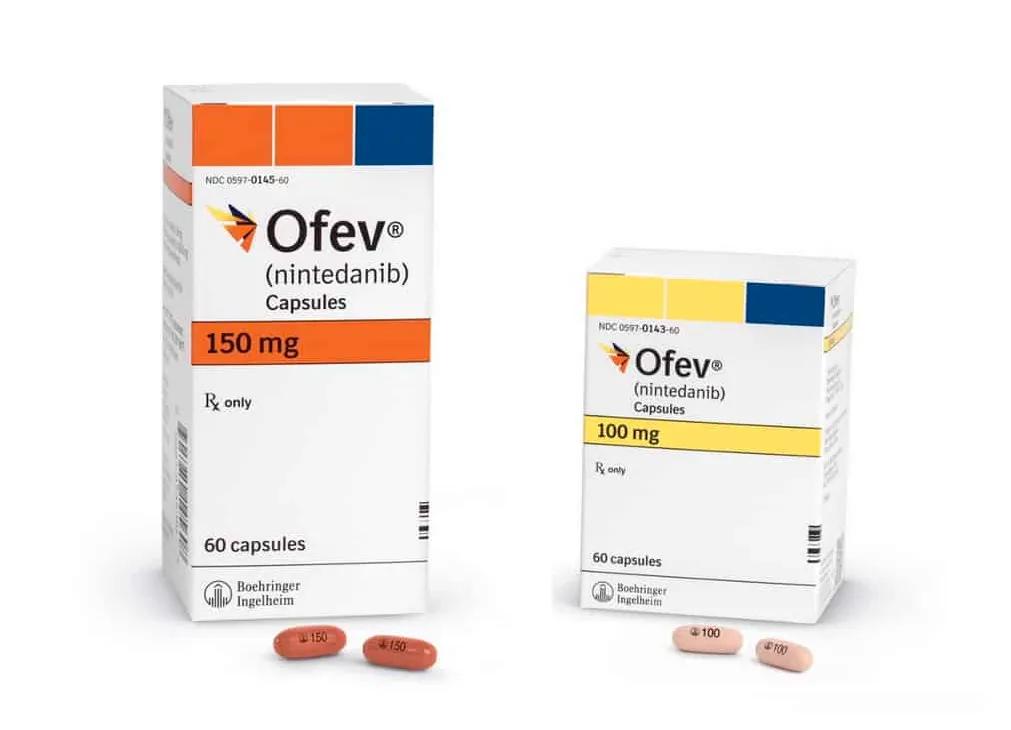
Brand Name: Ofev, generics
Drug Group: Tyrosine kinase inhibitor (antifibrotic, antineoplastic)
Commonly Used For
- Treat idiopathic pulmonary fibrosis (IPF).
- Manage non-small cell lung cancer (NSCLC).
- Slow disease progression in fibrotic conditions.
Key Characteristics
Form: Oral soft capsules (100 mg, 150 mg) (detailed in Dosage section).
Mechanism: Inhibits vascular endothelial growth factor (VEGF), platelet-derived growth factor (PDGF), and fibroblast growth factor (FGF) receptors.
Approval: FDA-approved (2014 for Ofev) and EMA-approved for IPF and NSCLC.
Indications and Uses of Nintedanib
Nintedanib is indicated for fibrotic lung diseases and cancers, leveraging its anti-angiogenic and anti-fibrotic properties:
Idiopathic Pulmonary Fibrosis (IPF): Treats IPF in adults, reducing the rate of lung function decline, supported by the INPULSIS trials, per pulmonary guidelines.
Systemic Sclerosis-Associated Interstitial Lung Disease (SSc-ILD): Manages SSc-ILD, slowing progression and improving forced vital capacity (FVC), with evidence from the SENSCIS trial.
Non-Small Cell Lung Cancer (NSCLC): Used with docetaxel for locally advanced or metastatic NSCLC after first-line chemotherapy, enhancing survival, per oncology protocols.
Chronic Hypersensitivity Pneumonitis: Investigated off-label to manage fibrotic progression in chronic hypersensitivity pneumonitis, with emerging pulmonology data.
Progressive Fibrosing Interstitial Lung Diseases (PF-ILD): Explored off-label for PF-ILD beyond IPF and SSc-ILD, improving lung function, supported by INBUILD trial results.
Hepatic Fibrosis: Used off-label to reduce liver fibrosis in non-alcoholic steatohepatitis (NASH), with preliminary hepatology research showing promise.
Ovarian Cancer: Investigated off-label in combination with chemotherapy for advanced ovarian cancer, targeting angiogenesis, with gynecologic oncology studies.
Renal Cell Carcinoma: Employed off-label for metastatic renal cell carcinoma resistant to other therapies, with urologic oncology evidence.
Mesothelioma: Explored off-label as an adjunct in malignant pleural mesothelioma, improving progression-free survival, noted in thoracic oncology research.
Alveolar Proteinosis: Investigated off-label for pulmonary alveolar proteinosis with fibrotic features, with early data from rare disease studies.
Dosage of Nintedanib
Dosage for Adults
Idiopathic Pulmonary Fibrosis (IPF) or SSc-ILD:
- Initial: 150 mg twice daily, taken with food.
- Maintenance: Adjust to 100 mg twice daily if tolerated, maximum 300 mg/day.
Non-Small Cell Lung Cancer (NSCLC):
- 200 mg twice daily, taken with food, with docetaxel, for up to 10 cycles or until disease progression.
Dosage for Children
Not approved for pediatric use; off-label use in rare cases (e.g., fibrotic lung disease) requires pediatric specialist supervision with weight-based dosing (e.g., 50–100 mg/m² twice daily), based on limited data.
Dosage for Pregnant Women
Pregnancy Category D: Avoid unless benefits outweigh risks (e.g., life-threatening cancer or IPF). Consult an obstetrician, with fetal monitoring.
Dosage Adjustments
Renal Impairment: No adjustment needed; monitor in severe cases (CrCl <30 mL/min).
Hepatic Impairment: Mild (Child-Pugh A): No adjustment; moderate (Child-Pugh B): Reduce to 100 mg twice daily; severe (Child-Pugh C): Avoid.
Elderly: Start with 100 mg twice daily; increase to 150 mg if tolerated.
Concomitant Medications: Adjust if combined with P-gp/CYP3A4 inhibitors (e.g., ketoconazole) or inducers (e.g., rifampin), altering levels.
Additional Considerations
- Take this active ingredient with food to reduce gastrointestinal irritation and enhance absorption.
- Use an antacid or proton pump inhibitor if needed, but space 2 hours apart.
How to Use Nintedanib
Administration:
- Swallow soft capsules whole with a meal or snack, using water; avoid crushing or chewing.
- Take at the same time daily (e.g., morning and evening) for consistency.
Timing: Use twice daily with meals, maintaining a regular schedule.
Monitoring: Watch for diarrhea, weight loss, or signs of liver issues (e.g., yellowing skin).
Additional Tips:
- Store at 20–25°C (68–77°F), protecting from moisture and heat.
- Keep out of reach of children due to toxicity risk.
- Report severe abdominal pain, persistent nausea, or signs of bleeding immediately.
Contraindications for Nintedanib
Hypersensitivity: Patients with a known allergy to Nintedanib or its components.
Severe Hepatic Impairment: Contraindicated in Child-Pugh Class C due to toxicity risk.
Gastrointestinal Perforation: Avoid in active cases or recent history.
Pregnancy: Contraindicated unless life-saving.
Side Effects of Nintedanib
Common Side Effects
- Diarrhea (50–60%, managed with loperamide)
- Nausea (20–30%, reduced with food)
- Abdominal Pain (15–25%, relieved with antacids)
- Loss of Appetite (10–20%, improved with nutrition support)
- Weight Loss (10–15%, monitored with dietary adjustments)
These effects may subside with dose reduction or supportive care.
Serious Side Effects
Seek immediate medical attention for:
- Hepatic: Jaundice, hepatotoxicity, or liver failure.
- Gastrointestinal: Perforation, obstruction, or severe bleeding.
- Cardiovascular: Hypertension, thromboembolism, or myocardial infarction.
- Pulmonary: Interstitial lung disease or acute respiratory distress.
- Allergic: Rash, angioedema, or anaphylaxis.
Additional Notes
- Regular monitoring for liver function, gastrointestinal health, and cardiovascular status is advised.
- Report any unusual symptoms (e.g., severe abdominal pain, shortness of breath) immediately to a healthcare provider.
Warnings & Precautions for Nintedanib
General Warnings
Hepatotoxicity: Risk of liver injury; monitor liver enzymes monthly for the first 3 months, then periodically.
Gastrointestinal Perforation: Rare but serious risk; discontinue if perforation or fistula occurs.
Bleeding Events: Increased risk, especially in patients on anticoagulants; monitor closely.
Cardiovascular Risk: Potential for hypertension or thromboembolism; check blood pressure regularly.
Diarrhea: Common and severe; manage with antidiarrheals and hydration.
Additional Warnings
Pulmonary Toxicity: Rare interstitial lung disease; assess respiratory symptoms.
Thrombosis: Risk of myocardial infarction or stroke; screen at-risk patients.
Skin Reactions: Rare exfoliative dermatitis; discontinue if severe.
Renal Impairment: Monitor in severe cases; adjust if necessary.
Hypersensitivity Reactions: Rare anaphylaxis; discontinue if swelling occurs.
Use in Specific Populations
Pregnancy: Category D; avoid unless critical; use contraception.
Breastfeeding: Avoid due to potential toxicity; monitor infant.
Elderly: Higher risk of side effects; start with lower doses.
Children: Not approved; use off-label only under specialist care.
Renal/Hepatic Impairment: Adjust dose; avoid in severe cases.
Additional Precautions
- Inform your doctor about liver disease, bleeding disorders, or medication history before starting this medication.
- Avoid abrupt cessation; taper if combined with other agents.
Overdose and Management of Nintedanib
Overdose Symptoms
- Diarrhea, nausea, or vomiting.
- Severe cases: Liver failure, gastrointestinal perforation, or bleeding.
- Fatigue, abdominal pain, or weight loss as early signs.
- Seizures or cardiovascular collapse with extremely high doses.
Immediate Actions
Contact the Medical Team: Seek immediate medical help.
Supportive Care: Administer IV fluids, monitor vital signs, and manage symptoms (e.g., antidiarrheals, blood transfusions).
Specific Treatment: No antidote; manage liver function and bleeding; consider activated charcoal if recent ingestion.
Monitor: Check liver enzymes, kidney function, and coagulation parameters for 24–72 hours.
Additional Notes
- Overdose risk is moderate; store securely.
- Report persistent symptoms (e.g., jaundice, severe weakness) promptly.
Drug Interactions with Nintedanib
This active ingredient may interact with:
- P-gp/CYP3A4 Inhibitors: Increases levels (e.g., ketoconazole); reduce dose to 100 mg twice daily.
- P-gp/CYP3A4 Inducers: Decreases levels (e.g., rifampin); monitor efficacy.
- Anticoagulants: Enhances bleeding risk (e.g., warfarin); monitor INR.
- Antacids/PPIs: Reduces absorption; space 2 hours apart.
- Antiarrhythmics: Potentiates QT prolongation; monitor ECG.
Action: Provide your healthcare provider with a complete list of medications.
Patient Education or Lifestyle
Medication Adherence: Take this tyrosine kinase inhibitor as prescribed to manage IPF or cancer, following the exact schedule.
Monitoring: Report diarrhea, weight loss, or jaundice immediately.
Lifestyle: Avoid alcohol; maintain a high-fiber diet to manage gastrointestinal effects.
Diet: Take with food; avoid grapefruit juice; use small, frequent meals if nauseated.
Emergency Awareness: Know signs of liver failure, bleeding, or perforation; seek care if present.
Follow-Up: Schedule regular check-ups every 1–3 months to monitor lung function, liver health, and weight.
Pharmacokinetics of Nintedanib
Absorption: Well-absorbed orally (peak at 2–4 hours); enhanced with food, reduced by antacids.
Distribution: Volume of distribution ~1,053 L; 97.8% protein-bound.
Metabolism: Hepatic via esterases to inactive metabolites, with minor CYP3A4 contribution.
Excretion: Primarily fecal (93%) as metabolites; renal (<1%); half-life 9–11 hours.
Half-Life: 9–11 hours, with sustained antifibrotic effects.
Pharmacodynamics of Nintedanib
This drug exerts its effects by:
- Inhibiting VEGF, PDGF, and FGF receptors, reducing angiogenesis and fibroblast proliferation.
- Slowing extracellular matrix deposition in fibrotic lung diseases like IPF.
- Demonstrating dose-dependent gastrointestinal and hepatic toxicity.
- Enhancing efficacy when combined with chemotherapy in NSCLC.
Storage of Nintedanib
Temperature: Store at 20–25°C (68–77°F); protect from moisture.
Protection: Keep in original blister pack, away from light.
Safety: Store in a locked container out of reach of children due to toxicity risk.
Disposal: Dispose of unused capsules per local regulations or consult a pharmacist.
Frequently Asked Questions (FAQs)
Q: What does Nintedanib treat?
A: This medication treats IPF and NSCLC.
Q: Can this active ingredient cause diarrhea?
A: Yes, diarrhea is common; manage with loperamide if advised.
Q: Is Nintedanib safe for children?
A: No, not approved; use off-label only with specialist care.
Q: How is this drug taken?
A: Orally as capsules twice daily with food, as directed.
Q: How long is Nintedanib treatment?
A: Long-term for IPF or until cancer progression.
Q: Can I use Nintedanib if pregnant?
A: No, avoid unless life-saving; consult a doctor.
Regulatory Information
This medication is approved by:
U.S. Food and Drug Administration (FDA): Approved in 2014 (Ofev) for IPF, expanded to SSc-ILD and NSCLC.
European Medicines Agency (EMA): Approved for IPF, SSc-ILD, and NSCLC.
Other Agencies: Approved globally for fibrotic lung diseases and cancer; consult local guidelines.
References
- U.S. Food and Drug Administration (FDA). (2023). Ofev (Nintedanib) Prescribing Information.
- Official FDA documentation detailing the drug’s approved uses, dosage, and safety.
- European Medicines Agency (EMA). (2023). Nintedanib Summary of Product Characteristics.
- EMA’s comprehensive information on the medication’s indications and precautions in Europe.
- National Institutes of Health (NIH). (2023). Nintedanib: MedlinePlus Drug Information.
- NIH resource providing detailed information on the drug’s uses, side effects, and precautions.
- World Health Organization (WHO). (2023). WHO Guidelines on Pulmonary Fibrosis: Nintedanib.
- WHO’s recommendations for Nintedanib in lung disease management.
- American Journal of Respiratory and Critical Care Medicine. (2022). Nintedanib in Progressive Fibrosing ILD.
- Peer-reviewed article on Nintedanib efficacy (note: access may require a subscription).
