
Comprehensive Guide to Dupilumab: Uses, Dosage, Side Effects, and More
What is Dupilumab?
Overview of Dupilumab
Generic Name: Dupilumab
Brand Name: Dupixent
Drug Group: Monoclonal antibody (biologic, immunomodulator)
Commonly Used For
This medication is used to:
- Treat moderate-to-severe atopic dermatitis.
- Manage severe asthma with type 2 inflammation.
- Control chronic rhinosinusitis with nasal polyps.
Key Characteristics
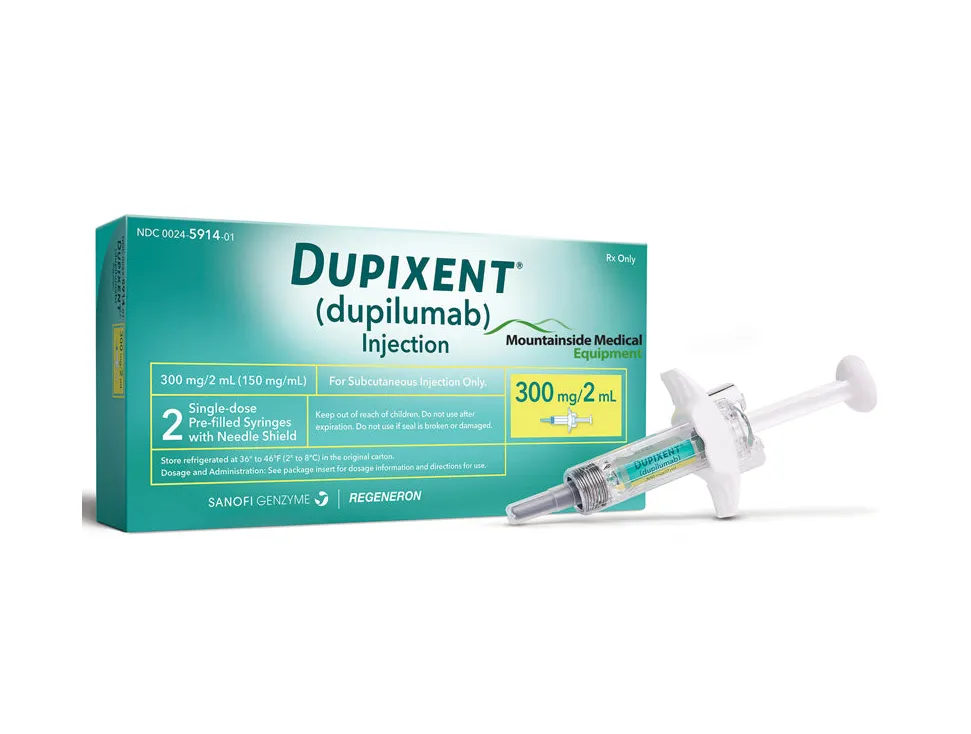
Form: Subcutaneous injection (200 mg, 300 mg pre-filled syringes or pens) (detailed in Dosage section).
Mechanism: Blocks IL-4 and IL-13 receptors, reducing inflammation and immune overactivity.
Approval: FDA-approved (2017 for Dupixent) and EMA-approved for multiple indications.
Indications and Uses of Dupilumab
Dupilumab is indicated for a range of allergic and inflammatory conditions, targeting type 2 immune responses:
Moderate-to-Severe Atopic Dermatitis: Treats eczema in patients (6+ months) inadequately controlled with topical therapies, reducing pruritus and lesion severity, supported by dermatology trials like SOLO 1 and SOLO 2.
Severe Asthma with Type 2 Inflammation: Manages asthma in patients (6+ years) with elevated eosinophils or FeNO, decreasing exacerbations, per pulmonary guidelines and LIBERTY ASTHMA QUEST study.
Chronic Rhinosinusitis with Nasal Polyps (CRSwNP): Controls nasal polyps in adults with inadequate response to intranasal corticosteroids, improving sinus function, evidenced by SINUS-24 and SINUS-52 trials.
Eosinophilic Esophagitis (EoE): Approved for EoE in patients (12+ years, weight ≥40 kg), reducing esophageal inflammation and dysphagia, supported by pediatric gastroenterology research.
Chronic Obstructive Pulmonary Disease (COPD): Investigated off-label for COPD with type 2 inflammation, improving lung function in select cases, with emerging pulmonology data.
Allergic Conjunctivitis: Explored off-label to alleviate ocular symptoms in atopic dermatitis patients, reducing redness and itching, noted in ophthalmology studies.
Food Allergy Management: Used off-label to reduce allergic responses in food-allergic patients, enhancing tolerance during oral immunotherapy, with allergology evidence.
Prurigo Nodularis: Managed off-label for severe prurigo nodularis, improving skin lesions and itch, supported by dermatologic research.
Bullous Pemphigoid: Investigated off-label for bullous pemphigoid, a rare autoimmune blistering disease, reducing disease activity, with preliminary dermatology findings.
Dosage of Dupilumab
Dosage for Adults
Atopic Dermatitis:
- Initial: 600 mg (two 300 mg injections) on day 1, then 300 mg every other week (q2w).
- Alternative: 300 mg q2w for less severe cases, with food allergy consideration.
Asthma: Initial: 400 mg (two 200 mg injections) or 600 mg (two 300 mg injections) on day 1, then 200 mg q2w or 300 mg q2w based on severity.
Chronic Rhinosinusitis with Nasal Polyps: Initial: 600 mg on day 1, then 300 mg q2w.
Eosinophilic Esophagitis: 300 mg q2w, after initial loading dose if transitioning from other indications.
Dosage for Children
Atopic Dermatitis (6 months–17 years):
- 6 months–5 years: 200 mg (15–<30 kg) or 300 mg (≥30 kg) q4w, with loading dose.
- 6–11 years: 300 mg q4w (15–<30 kg) or 200 mg q2w (30–<60 kg), 300 mg q2w (≥60 kg).
- 12–17 years: Adult dosing (300 mg q2w), under pediatric dermatology supervision.
Asthma (6–17 years):
- 6–11 years: 100 mg q2w (15–<30 kg), 200 mg q2w (30–<60 kg), 300 mg q2w (≥60 kg).
- 12–17 years: Adult dosing, adjusted by weight.
Dosage for Pregnant Women
Pregnancy Category C: Limited data; use only if benefits outweigh risks. Consult an obstetrician, with fetal monitoring and dose adjustment if needed.
Dosage Adjustments
Renal Impairment: No adjustment needed; monitor in severe cases (CrCl <30 mL/min).
Hepatic Impairment: No adjustment needed; monitor in severe cases (Child-Pugh C).
Elderly: Start with standard dosing; increase cautiously if tolerated.
Concomitant Medications: No significant interactions; monitor if combined with immunosuppressants.
Additional Considerations
- Administer this active ingredient via subcutaneous injection, rotating sites (e.g., thigh, abdomen).
- Provide patient training for self-administration with proper technique.
How to Use Dupilumab
Administration:
- Inject subcutaneously using pre-filled syringe or pen into the thigh, abdomen (avoid 2 inches around navel), or upper arm (with assistance).
- Rotate injection sites to prevent irritation; do not shake the syringe.
Timing: Use every other week (q2w) or every 4 weeks (q4w) as prescribed, maintaining consistency.
Monitoring: Watch for injection-site reactions, eye symptoms, or signs of allergic response (e.g., swelling).
Additional Tips:
- Store at 2–8°C (36–46°F) in the refrigerator; allow to reach room temperature (45 minutes) before use.
- Keep out of reach of children due to medication error risk.
- Report severe redness, vision changes, or signs of infection immediately.
Contraindications for Dupilumab
Hypersensitivity: Patients with a known allergy to Dupilumab or its excipients.
Severe Active Infections: Avoid during uncontrolled infections (e.g., sepsis).
Warnings & Precautions for Dupilumab
General Warnings
Hypersensitivity Reactions: Risk of anaphylaxis or angioedema; monitor post-injection.
Conjunctivitis and Keratitis: Increased risk of ocular complications; refer to an ophthalmologist if persistent.
Eosinophilic Conditions: Possible eosinophilia or hypereosinophilic syndrome; monitor blood counts.
Parasitic Infections: Risk of exacerbation in helminth infections; treat before use.
Immunosuppression: May alter immune response; avoid live vaccines during therapy.
Additional Warnings
Arthralgia: Joint pain reported; assess for underlying conditions.
Skin Infections: Risk of eczema herpeticum or bacterial infections; monitor skin integrity.
Cardiovascular Effects: Rare reports of vasculitis; monitor in at-risk patients.
Neurological Symptoms: Rare facial paralysis or paresthesia; report immediately.
Cancer Risk: Long-term data limited; monitor for malignancy signs.
Use in Specific Populations
Pregnancy: Category C; use only if essential with fetal monitoring.
Breastfeeding: Excreted in breast milk; monitor infant for effects.
Elderly: Higher risk of side effects; start with standard dosing.
Children: Limited to 6 months+ for atopic dermatitis, 6+ years for asthma; supervise closely.
Renal/Hepatic Impairment: No adjustment needed; monitor in severe cases.
Additional Precautions
- Inform your doctor about infections, eye conditions, or medication history before starting this medication.
- Avoid abrupt cessation; consult for tapering if needed.
Overdose and Management of Dupilumab
Overdose Symptoms
- Injection-site reactions, headache, or mild fatigue.
- Severe cases: Hypersensitivity reactions or eosinophilic disorders.
- Nausea, dizziness, or rash as early signs.
- No life-threatening effects reported with excess doses.
Immediate Actions
Contact the Medical Team: Seek immediate medical help.
Supportive Care: Monitor vital signs, manage allergic reactions with antihistamines or epinephrine if needed.
Specific Treatment: No antidote; observe for 24 hours.
Monitor: Check eosinophil levels, liver function, and injection site for 24–48 hours.
Additional Notes
- Overdose risk is low; store securely.
- Report persistent symptoms (e.g., severe rash, vision changes) promptly.
Side Effects of Dupilumab
Common Side Effects
- Injection-Site Reactions (10–20%, mild redness or swelling)
- Conjunctivitis (5–15%, manageable with eye drops)
- Headache (4–12%, relieved with rest)
- Oral Herpes (2–10%, treat with antivirals)
- Fatigue (3–8%, decreases with tolerance)
These effects may subside with continued use.
Serious Side Effects
Seek immediate medical attention for:
- Ocular: Keratitis, blepharitis, or vision loss.
- Allergic: Anaphylaxis, angioedema, or serum sickness.
- Eosinophilic: Hypereosinophilic syndrome or pulmonary infiltrates.
- Infectious: Eczema herpeticum or severe skin infections.
- Neurological: Facial paralysis or paresthesia.
Additional Notes
- Regular monitoring for eye health, eosinophil counts, and skin infections is advised.
- Report any unusual symptoms (e.g., severe eye pain, swelling) immediately to a healthcare provider.
Drug Interactions with Dupilumab
This active ingredient may interact with:
- Live Vaccines: Reduces immune response; avoid during therapy.
- Immunosuppressants: May enhance or reduce effects; monitor closely.
- Corticosteroids: Potential additive effects; adjust dose if combined.
- Antihistamines: No significant interaction; use for symptom relief.
- Cytochrome P450 Substrates: Minimal impact; monitor if co-administered.
Action: Provide your healthcare provider with a complete list of medications.
Patient Education or Lifestyle
Medication Adherence: Take this biologic as prescribed (e.g., q2w or q4w), following the exact schedule.
Monitoring: Report eye symptoms, injection-site issues, or fatigue immediately.
Lifestyle: Avoid allergens if possible; maintain skin hydration.
Diet: No specific restrictions; ensure adequate nutrition.
Emergency Awareness: Know signs of allergic reactions or ocular issues; seek care if present.
Follow-Up: Schedule regular check-ups every 3–6 months to monitor disease control, eye health, and eosinophil levels.
Pharmacokinetics
Absorption: Subcutaneous bioavailability ~64%; peak at 3–7 days.
Distribution: Volume of distribution ~4.8 L; binds to IL-4Rα with high affinity.
Metabolism: Degraded via proteolysis into small peptides, no CYP involvement.
Excretion: Eliminated through the reticuloendothelial system; half-life 21–36 days.
Half-Life: 21–36 days, with sustained therapeutic levels.
Pharmacodynamics
This drug exerts its effects by:
Inhibiting IL-4 and IL-13 signaling via IL-4Rα blockade, reducing Th2-driven inflammation.
Decreasing eosinophil counts, IgE levels, and inflammatory cytokines in type 2 diseases.
Improving skin barrier function in atopic dermatitis and airway remodeling in asthma.
Exhibiting dose-dependent risks of conjunctivitis and injection-site reactions.
Storage
Temperature: Store at 2–8°C (36–46°F) in the refrigerator; do not freeze.
Protection: Keep in original carton to protect from light.
Safety: Store in a locked container out of reach of children.
Disposal: Dispose of used syringes in a sharps container per local regulations or consult a pharmacist.
Frequently Asked Questions (FAQs)
Q: What does Dupilumab treat?
A: This medication treats atopic dermatitis, asthma, and nasal polyps.
Q: Can this active ingredient cause eye issues?
A: Yes, conjunctivitis may occur; consult an eye doctor if persistent.
Q: Is Dupilumab safe for children?
A: Yes, for 6 months+ with a doctor’s guidance.
Q: How is this drug taken?
A: Via subcutaneous injection every other week, as directed.
Q: How long is Dupilumab treatment?
A: Long-term for chronic conditions with monitoring.
Q: Can I use Dupilumab if pregnant?
A: Yes, with caution; consult a doctor.
Regulatory Information
This medication is approved by:
U.S. Food and Drug Administration (FDA): Approved in 2017 (Dupixent) for atopic dermatitis, expanded to asthma, CRSwNP, and EoE.
European Medicines Agency (EMA): Approved for multiple indications.
Other Agencies: Approved globally for allergic and inflammatory diseases; consult local guidelines.
References
- U.S. Food and Drug Administration (FDA). (2023). Dupixent (Dupilumab) Prescribing Information.
- Official FDA documentation detailing the drug’s approved uses, dosage, and safety.
- European Medicines Agency (EMA). (2023). Dupilumab Summary of Product Characteristics.
- EMA’s comprehensive information on the medication’s indications and precautions in Europe.
- National Institutes of Health (NIH). (2023). Dupilumab: MedlinePlus Drug Information.
- NIH resource providing detailed information on the drug’s uses, side effects, and precautions.
- World Health Organization (WHO). (2023). WHO Guidelines on Allergic Diseases: Dupilumab.
- WHO’s recommendations for Dupilumab in allergic conditions.
- Journal of Allergy and Clinical Immunology. (2022). Dupilumab in Type 2 Inflammation.
- Peer-reviewed article on Dupilumab efficacy (note: access may require a subscription).
